TLDR
Anthropic hit a staggering $30B revenue run rate, fueled by its new Managed Agents and a platform strategy that’s disrupting early agent startups. This week, we're seeing the AI industry face critical questions about its core purpose and leadership ethics, while the shift to AI-native organizations means executive roles are changing and "dark factories" of code are emerging. Founders are navigating new pathways to exit through productized AI agencies and grappling with model degradation, underscoring the urgency of strategic compute and security.
The Big Picture: Redefining AI's Trajectory & Organizational DNA
Anthropic's Agent Gambit & $30B Ramp: A New AI Economy Blueprint

Anthropic has reached an unprecedented $30B revenue run rate, adding $11B in just one month and surpassing OpenAI in scale, with over 1,000 enterprises paying $1M+ annually for its models Anthropic Blog (1 min read), Aakash Gupta (4 min read). This surge is concurrent with the launch of Claude Managed Agents, a move that an analyst claims has "mass-obsoleted every agent orchestration startup" by handling 90% of infrastructure complexity Aakash Gupta (3 min read), Vox (2 min read). This isn't just growth; it's a strategic play where model providers absorb the agent stack, challenging the notion of standalone agent startups and intensifying the "hyperscaler war" for compute needed to fuel this demand Brad Gerstner on All-In (90min, 0:43:01).
Your angle with founders: "Anthropic's $30B ramp shows model providers are absorbing the agent stack. That's great if you're building on their platform — but what happens when your agent infrastructure is owned by a company that also competes for your customers? The founders thinking ahead are building on multi-model infrastructure so they can use the best agents without being locked into any single provider's ecosystem."
AI's Existential Debate: Curing Cancer vs. Products & The Compute Bottleneck

DeepMind CEO Demis Hassabis, Nobel Prize winner for AlphaFold, reflects that if he "had my way, I would have left AI in the lab for longer... Maybe cured cancer" before the commercial AI race redirected focus to products Ricardo (4 min read). He frames AGI as "10x the industrial revolution at 10x the speed," likely within five years, but identifies compute as the biggest bottleneck for both scaling existing ideas and experimenting with new algorithmic innovations Demis Hassabis on 20VC (32min). This underscores a critical tension between scientific breakthroughs, rapid commercialization, and the foundational resource limits for truly transformative AI.
Your angle with founders: "Demis Hassabis says AGI is likely within five years but compute is the biggest bottleneck. How are you thinking about your compute strategy, not just for scaling, but for the fundamental algorithmic R&D that will differentiate you?"
The Org Chart Reshuffle: Executive Compression & AI-Native Teams
The rise of AI tools is triggering "executive compression," pushing CTOs back into individual contributor roles at leading AI labs like Anthropic Aakash Gupta (2 min read). Postman's founder similarly advises to "kill your org chart for AI," advocating for wide spans of control, direct work with ICs, and projects led by high-agency staff engineers Ivan Burazin (2 min read). Legendary investor Keith Rabois adds that the traditional Product Manager role is becoming obsolete, with future success lying in business acumen and knowing "what to build," not just managing process Keith Rabois on Lenny's Podcast (83min, 0:00).
Your angle with founders: "Executive compression means your best technical leaders are going back to building. But they need the right tools to make that work — AI-assisted coding, managed infrastructure, architecture reviews. We're seeing the most effective teams pair senior talent with tools like Gemini Code Assist and Cloud Workstations so they're not just closer to the code, they're 10x more effective at it. Want us to run a workshop on what an AI-native team structure looks like for your stack?"
Builder's Corner
Agent Harness Wars & Managed Agents: Model-Provider-Led Infra
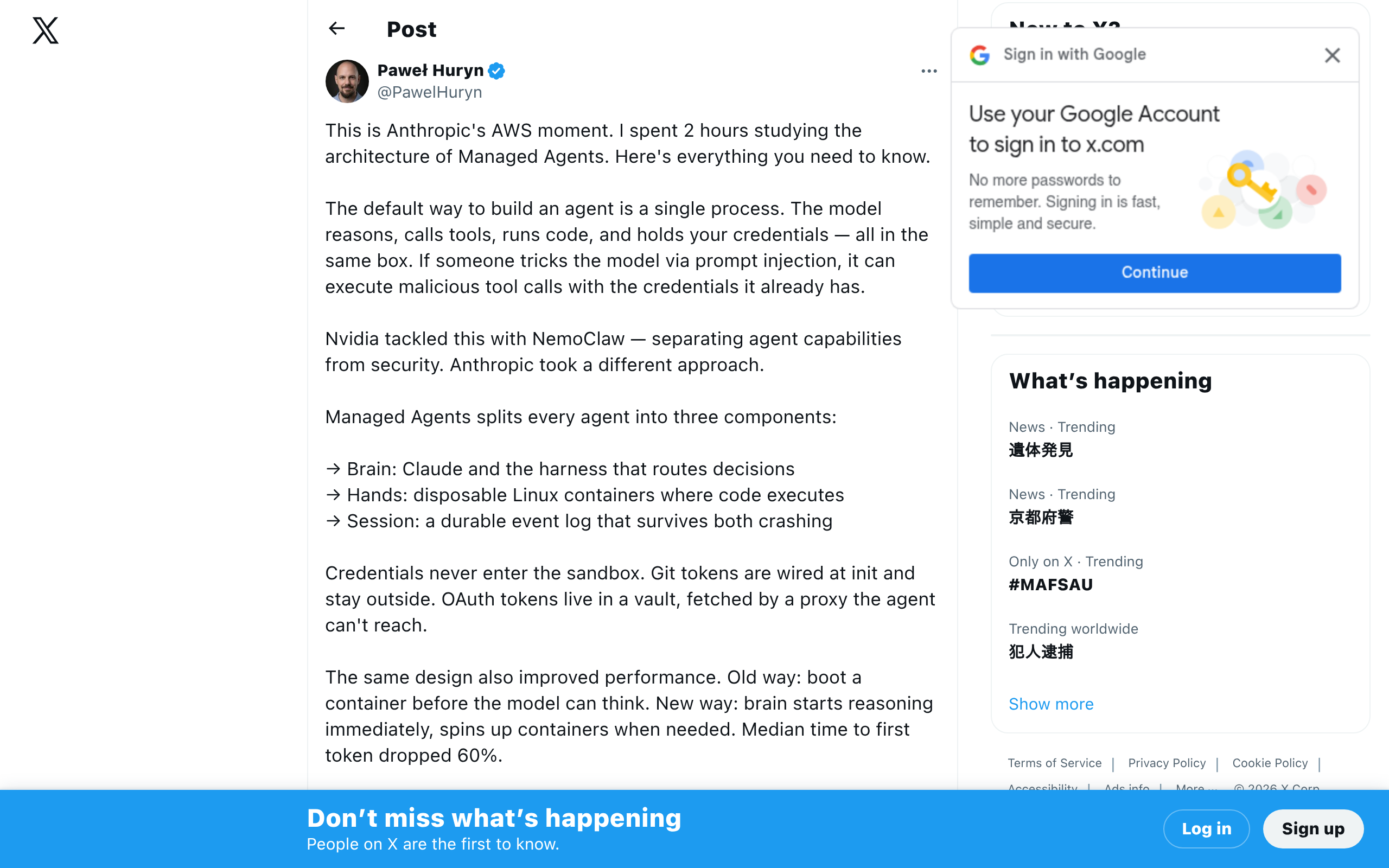
The new Claude Managed Agents from Anthropic reveal a deep technical strategy: a "Brain/Hands/Session" split that allows the model (Brain) to reason immediately while execution (Hands) happens in disposable containers, dramatically cutting latency and improving reliability Paweł Huryn (3 min read). This "thin harness" philosophy, where the model makes most decisions, contrasts with thicker, more explicit control architectures like LangGraph Akshay Pachaar (5 min read). OpenAI echoes this, with engineers focused on "harness engineering" and letting agents boot their own stack, treating human attention as the true bottleneck Ryan Lopopolo on Latent Space (78min, 0:10:15).
Why founders care: The harness debate — thick vs. thin, managed vs. open-source — is really about control vs. convenience. The founders who win long-term are the ones who can experiment with both approaches without rearchitecting every time the landscape shifts. That's where model-agnostic infrastructure matters: Vertex AI Agent Builder lets you run Anthropic's thin-harness agents, LangGraph's thicker orchestration, or your own custom stack on the same platform. Ask founders: "Which harness philosophy fits your use case — and are you locked into it, or can you switch?"
The 'Dark Factory' Comes Alive: AI Writing 95% of Code
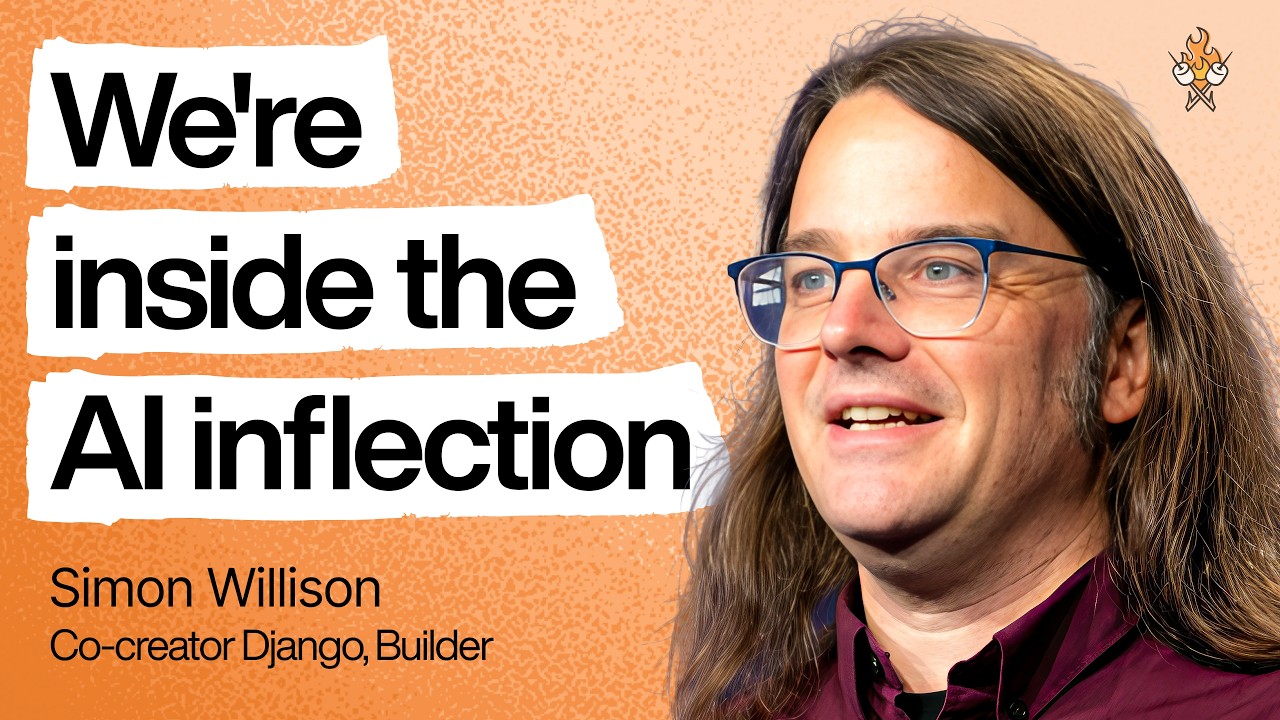
The "dark factory" of software development is here: "95% of the code that I produce, I didn't type it myself," notes one AI engineer, often coding on his phone while walking the dog Simon Willis on Lenny's Podcast (100min, 0:04:50). Another founder reports getting the "first 80% from AI" for blog posts and coding Peter Yang on a16z Podcast (30min, 0:19:50). This rapidly shifts the bottleneck from writing code to ideation and debugging, with predictions that 95% of all code will be AI-generated in the next few years David Sacks on All-In (90min, 0:37:34).
Why founders care: If AI writes 95% of the code, your moat isn't engineering speed anymore — it's knowing which problems are worth solving. The provocative question for founders: "How do you actually know what to build?" The companies pulling ahead aren't just generating code faster — they're validating ideas faster, testing with real users earlier, and killing bad bets before the AI writes 10,000 lines of code nobody needs. Engineering becomes a judgment game, not a typing game.
Founder Watch
Sam Altman's Trust Crisis & OpenAI's Legal Gauntlet
A New Yorker investigation, based on over 100 interviews and internal documents, alleges a "consistent pattern of... Lying" by Sam Altman, with former OpenAI board members describing a "sociopathic lack of concern for consequences of deceiving someone" Ryan (5 min read), Katie Miller (2 min read). This comes as the Musk vs. Altman trial (April 27) looms, questioning whether OpenAI's conversion from non-profit to for-profit (now eyeing an $850B IPO) is legal, potentially impacting the legal foundation of the entire AI industry for companies built on public benefit promises Ricardo (5 min read).
Conversation starter: "The OpenAI governance saga is a reminder that trust and corporate structure matter — not just for them, but for every AI company. As your startup scales and takes on more enterprise customers, how are you thinking about governance, transparency, and the kind of foundation that gives investors and customers long-term confidence?"
Productized AI Agencies: The Clearest Path to a $10M+ Exit
Greg Isenberg lays out a detailed playbook for achieving a $10M+ software exit in two years by starting a productized AI agency Greg Isenberg (4 min read). The strategy involves picking one painful deliverable for a specific buyer (e.g., SEO content for e-commerce), building an AI workflow, selling it on a $3-5K/month retainer with 80%+ margins, and then using the agency as R&D to productize into a SaaS. This capital-efficient model can lead to $1.9M ARR in two years with a projected 5-8x revenue exit.
Conversation starter: "Many founders are looking for capital-efficient paths to exit. Have you considered the 'productized AI agency' model as a launchpad for your SaaS, leveraging AI to achieve high margins and rapid product validation?"
Model Degradation Spurs Local AI Adoption
Data from 6,852 Claude Code sessions reveal a concerning degradation in Claude Opus 4.6, with thinking depth dropping 67% and "lazy behavior violations" increasing Noah Epstein (2 min read). This quiet degradation, prior to a new product launch, has prompted some developers to shift towards local models like Gemma 4 and GLM that "don't get quietly worse." This highlights the critical importance of model reliability and control for founders.
Conversation starter: "Are you benchmarking your model performance over time? Reports of quiet capability changes from providers are a reminder that no single model contract guarantees consistency. The teams building resilience are running evals across multiple providers — have you recently compared Gemini against the models you're relying on? Multi-model strategies on Vertex AI let you A/B test and switch without re-engineering your stack."
Non-Tech Companies Are AI-Native Too: The Roofing Example
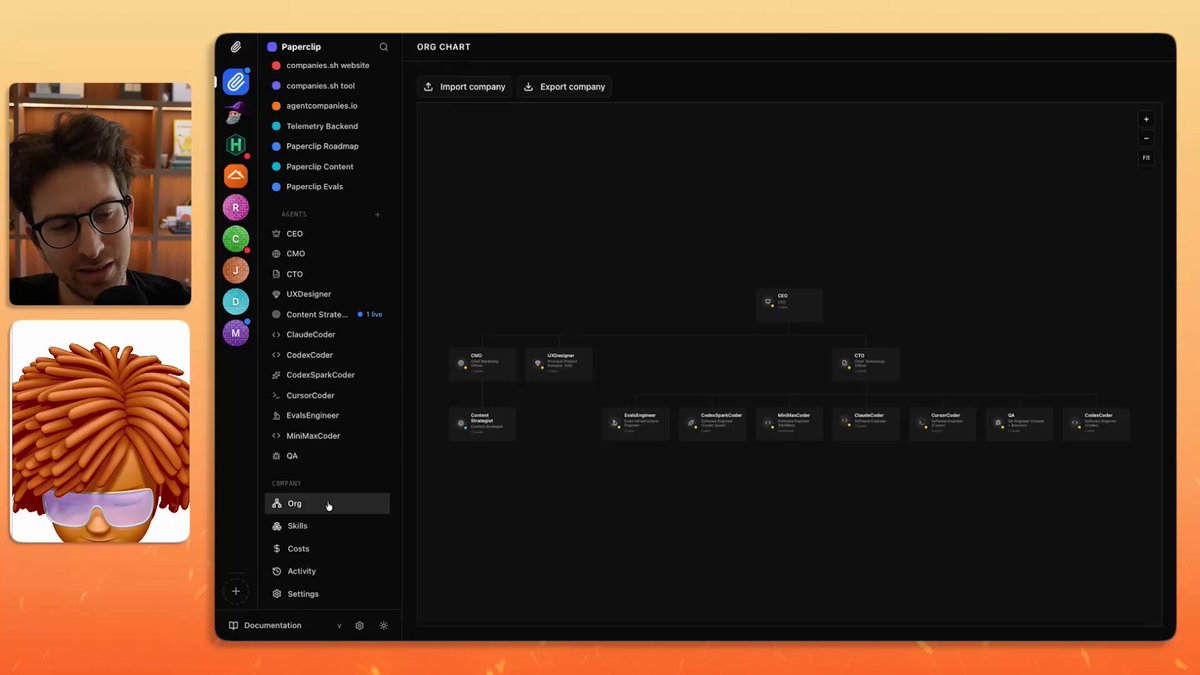
It's not just tech startups adopting AI agents. A roofing company is using AI agents to pull satellite imagery, cross-reference hail damage, and feed warm leads directly to its sales team Mario Nawfal (1 min read). This non-tech business is leveraging AI agents for core operations, demonstrating a widespread horizontal adoption pattern that bypasses traditional tech-first approaches.
Conversation starter: "A roofing company is using AI agents to find hail damage and generate leads. Where in your business, perhaps outside your core tech, could AI agents be deployed to automate critical operations and create a competitive edge?"
Quick Hits
- AWS S3 Files: Native Filesystem for AI Agents (1 min read) — Amazon's S3 Files mounts any S3 bucket as a native NFS, offering close-to-open consistency and simplifying durable storage for agent runtimes.
- Meta's Muse Spark: Natively Multimodal Reasoning (1 min read) — Meta AI launched Muse Spark, their first natively multimodal reasoning model with tool-use and multi-agent orchestration, now available on meta.ai with a private API preview.
- AI Avatar with Permanent Character Consistency (1 min read) — Avatar V introduces an AI avatar model that maintains consistent character and mannerisms from a 15-second recording, creating lifelike video from any photo.
Try This Week
Install claude-usage, an open-source local dashboard, to track your Claude Code token consumption. Share the insights with your team to kickstart a conversation about prompt efficiency, agent loop optimization, and overall cost management as you build with AI. Remember, unseen costs are uncontrolled costs.
Our Play
The Secure & Scalable Backbone for Agent Innovation
Anthropic's Managed Agents and its $30B ramp highlight the urgent need for a secure, scalable platform that can handle massive agent compute demands while ensuring safety. Google Cloud's Vertex AI Agent Builder provides the managed infrastructure for building and orchestrating custom agents, supporting the open A2A protocol for inter-agent communication. For the "cyber reckoning" warned by industry leaders, our Security Command Center, powered by Mandiant threat intelligence, delivers AI-native detection and autonomous response to secure these complex agent ecosystems. This infrastructure, coupled with high-performance TPUs and Google for Startups Cloud credits, directly addresses the compute bottlenecks and security concerns that define this new AI era.
Connect to this week: As model providers enter the agent infrastructure game and AI-driven cyber threats escalate, Google Cloud offers the enterprise-grade platform to build, secure, and scale your agent innovations, ensuring both performance and trust.
Empowering 'Dark Factory' Developers with Gemini & Open Models
The "dark factory" of AI-generated code and the shifting roles in AI-native organizations demand tools that amplify developer productivity and empower the "IC-led" revolution. Gemini Code Assist provides comprehensive code generation, testing, and deployment support to accelerate development, allowing teams to focus on ideation rather than boilerplate. Developers can leverage Vertex AI Model Garden to access Gemini and over 200 open-source models, crucial for avoiding single-model lock-in and mitigating the risks of model degradation. By providing choice and powerful assistance, Google Cloud supports founders in building the lean, efficient, AI-native teams that define today's successful startups.
Connect to this week: With 95% of code potentially AI-generated, Google Cloud provides the tools and model choice—from Gemini Code Assist to a diverse Model Garden on Vertex AI—to empower your engineers to build faster, smarter, and with greater control in the age of the 'dark factory.'