TLDR
- AI spend gets lean. Coinbase slashes AI costs by nearly half through smart routing, caching, and model defaults.
- Context is the new lock-in. Claude Tag highlights how company memory, not just models, becomes a vendor's sticky moat.
- Hardware squeeze intensifies. DRAM and HBM (High Bandwidth Memory) are the critical AI bottlenecks, driving interest in modular compute and orbital visions.
- Open-weight models surge. GLM 5.2 shows open weights are nearing frontier quality, accelerating China's AI playbook.
- Agents create "spaghetti code." AI-generated code leads to new roles in "meta-cognition" and curation, rather than eliminating engineers.
- GCP plays this week: Own the context layer on GEAP, keep models swappable, and engineer the token bill down with provisioned throughput, context caching, and committed-use terms.
The Big Picture: The New Economics of AI
The Token Wars: How Enterprises Are Slashing AI Spend
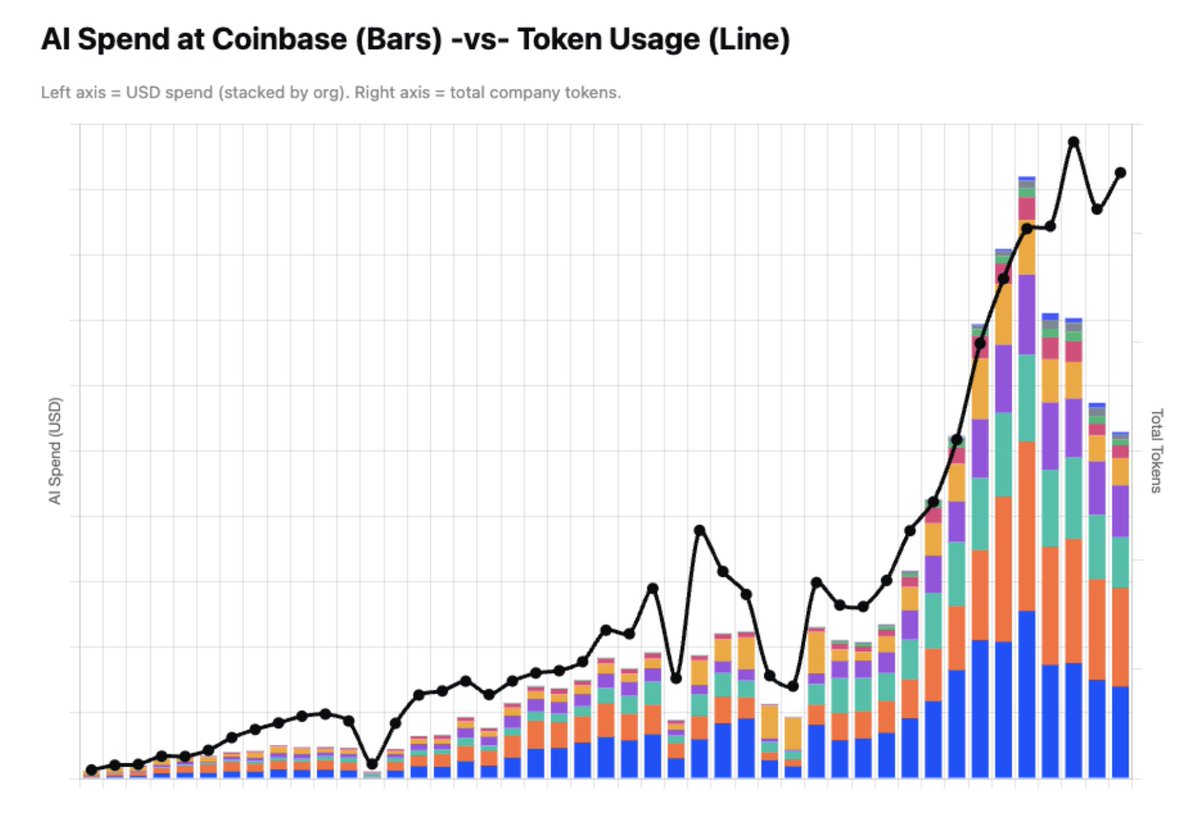
Coinbase just announced it cut AI spend by nearly half while token usage grew exponentially, showcasing a new era of "token engineering." Their strategy: cheaper defaults (like GLM 5.2 over frontier models), intelligent, cache-aware routing that sends prompts to the best model for the job, and keeping context lean Brian Armstrong on X (1 min read). SemiAnalysis, meanwhile, notes its token spend hits 30% of employee compensation SemiAnalysis on X (1 min read). Nikesh Arora (Palo Alto Networks) warns labs that high token pricing for enterprises pushes them to secure open-source alternatives, urging frontier labs to "forward-price tokens now" to unlock experimentation Nikesh Arora on X (1 min read). This isn't about using less AI; it's about using the right token, on the right model, at the right time, with the right cache nicbstme on X (1 min read).
Your angle with founders:
- Where it hurts: "What does your token spend look like as a percentage of your engineering budget today, and where is it growing fastest?"
- How they're hedging: "Are you architecting for multi-model routing and cache-aware inference, or are you running everything on a single frontier model by default?"
- Where the GCP opportunity is: AWS-Bedrock-to-GEAP migrations (same models, lower switching cost) | Provisioned throughput contracts on Gemini | New compute commitments (especially for composable AI architectures) | Agentic Data Cloud for fine-grained routing and cost-optimized retrieval.
Context Lock-In: The Real AI Moat of the Agent Era
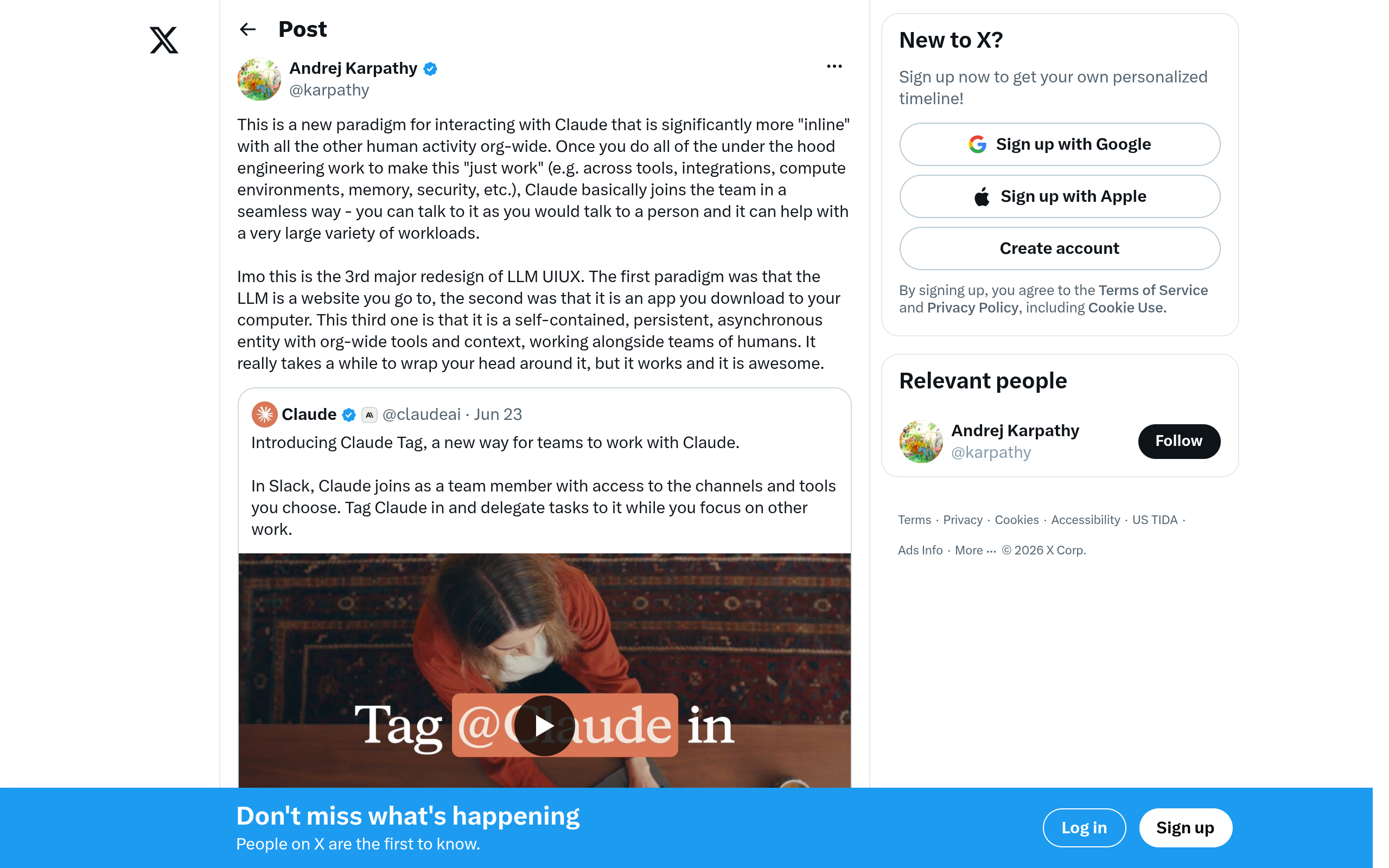
Anthropic's Claude Tag, which lets you "tag" Claude as a teammate in Slack or MS Teams, is being hailed as a "3rd major redesign of LLM UI/UX" Karpathy on X (1 min read). But some observers are calling it a "Trojan horse": it integrates AI so deeply into your company's coordination layer—remembering threads, connecting tools, acting like a coworker—that the real lock-in isn't the model itself, but your company's context Ashwin Gopinath on X (1 min read). This "context lock-in" shifts economic value to the AI vendor, effectively allowing them to "rent your company back from them." The structural function, it's argued, is "labor absorption," repricing white-collar work by turning coordination into tokenized activity The Prophet on X (1 min read). The counter-strategy: "rent the best intelligence from whoever is best this month… but own the context layer."
Your angle with founders:
- Where it hurts: "How much of your team's institutional knowledge—the undocumented decisions, the exception paths, the answers buried in old chat threads—is now flowing into third-party AI agents, and who owns that data?"
- How they're hedging: "Is your company's memory inspectable, permissioned, and portable across models and vendors, or are you building new knowledge silos with every AI integration?"
- Where the GCP opportunity is: Agentic Data Cloud, with Knowledge Catalog and Data Agent Kit, lets founders own and govern their context layer. Gemini Enterprise Agent Platform (FKA Vertex AI) provides a neutral, multi-model substrate, allowing founders to swap models and integrate agents without ceding their strategic company memory.
The Hardware Squeeze: DRAM, Modular Compute, and Orbital Visions

HBM and DRAM are the "most important bottleneck" in AI infrastructure, with Micron reporting its entire 2026 supply already sold out and forecasting 86% gross margins in Q4 Gavin Baker on All-In (102min, 1:05:07). This scarcity is driving up the cost of compute across the board, including consumer electronics. Building a 1-gigawatt terrestrial data center now costs around $60 billion ($35B for Nvidia semiconductors, $25B for power/cooling) Gavin Baker on All-In (102min, 1:26:01). The response: a surge of interest in modular "Megapod" data centers, capable of 90-day build cycles Chamath Palihapitiya on All-In (102min, 1:18:24), and even speculative orbital compute, potentially $20 billion cheaper for a gigawatt than terrestrial options Gavin Baker on All-In (102min, 1:27:11).
Your angle with founders:
- Where it hurts: "Compute pricing is getting more volatile as memory supply tightens—how are you budgeting compute and locking in capacity for the next year so a sudden price or availability swing doesn't stall your roadmap?"
- How they're hedging: "Are you thinking about compute infrastructure as a fungible commodity, or as a strategic asset that requires long-term commitments and diversified supply chain planning?"
- Where the GCP opportunity is: Committed-use agreements that lock in price and capacity for the customer's actual workload mix (TPUs and GPUs), insulating them from spot-market swings | Model optionality on one platform so they're never forced onto whatever happens to be scarce | Flexible commitment terms as the lever—not raw capacity claims.
Founder Watch: Navigating the AI Landscape
Google's Talent Drain Continues, Gemini 3.5 Pro Delayed
Google DeepMind is experiencing ongoing talent departures, following last week's news of Noam Shazeer (Transformer co-inventor) to OpenAI and John Jumper (AlphaFold lead) to Anthropic. New reports signal more senior researchers leaving AI Daily Brief (31min, 00:18:30). Simultaneously, Gemini 3.5 Pro, initially expected in June, is delayed to July, undergoing "tweaking" based on early tester feedback for real-world coding use cases AI Daily Brief (31min, 00:19:20). This comes as Chinese open-weight models like GLM 5.2 rapidly close the gap, with one report noting that GLM 5.2 has surpassed Google's Gemini models—and potentially Fable 5—in specific areas like coding and long-context work Theo on AI Daily Brief (30min, 00:27:00).
Trusting Agents: Non-Deterministic AI & The Imperfect Audit Report
Enterprise adoption of AI agents is stalling on a basic gap: there's no auditable standard for "is this agent safe enough to deploy?" The Artificial Intelligence Underwriting Company (AIUC) is borrowing the playbook that made other risky technologies insurable—a flywheel of standards → audits → insurance, the same structure as cyber insurance. Their case for why it's needed now: frameworks like the NIST AI Risk Management Framework and CSA's AI controls are useful guidance but aren't prescriptive or certifiable, so an underwriter has nothing concrete to price against Emil Lawson on Practical AI (46min, 0:34:00). The hard part is defining what "passing" means: because every agentic system is non-deterministic—jailbreakable and able to hallucinate under enough pressure—a 100% spotless audit is impossible, and chasing one makes the agent "so dumb it can't actually do the job." So the model is to mitigate the critical (P0/P1) vulnerabilities, then disclose the residual risk honestly—"a spotless audit report is probably not as valuable as an audit report that reflects reality more clearly" Emil Lawson on Practical AI (46min, 0:36:00). AIUC is already certifying agents from ElevenLabs, Finn, and UiPath, and plans to plug its framework into the GRC (governance, risk, and compliance) platforms enterprises already run.
Quick Hits
- Bot traffic now surpasses human traffic online (89 min watch) — Cloudflare reports bot traffic passed human traffic in H1 2026, projected to increase 1,000x in 5 years due to AI.
- SemiAnalysis token spend hits 30% of employee comp (1 min read) — SemiAnalysis reports its token spend is ~30% of employee compensation, pulling 5 billion tokens/month per employee.
- DeepSeek's DSpark boosts LLM throughput 51-400% (1 min read) — DeepSeek published DSpark, a speculative decoding method boosting LLM throughput by 51-400%, open-sourcing its training framework.
- The KV cache is the next memory bottleneck (45 min watch) — Startups like Engram are baking evolving context directly into model weights to escape RAG's limits; one Wikipedia article in a 70B model's KV cache can eat 80GB of HBM—nearly its entire weight footprint.
Our Play
Help Founders Own Their Context Layer While Staying Model-Optional
Connecting to "The Token Wars" and "Context Lock-In," the play is to position Gemini Enterprise Agent Platform (FKA Vertex AI) as the neutral substrate that lets a founder capture the upside of agents without handing their company's memory to a single model vendor. The pitch isn't a product—it's "rent the best intelligence each month, but own the context underneath it." Here's how a rep walks it onto Google Cloud:
- Land the context layer first. Get the customer's documents, tickets, code, and chat history into BigQuery plus a managed RAG/search store on GEAP, governed by their own IAM and Dataplex catalog. The data and the access controls stay theirs—inspectable, permissioned, and portable—so the "context lock-in" the market fears works in the customer's favor, not the vendor's.
- Make models swappable on top of it. Serve Gemini, Claude, and cost-optimized open-weight models (Gemma) from GEAP's Model Garden behind one interface, so the team can route each task to the best model this month without re-plumbing their context or migrating data.
- Engineer the token bill down. Provisioned throughput for predictable agent loops, context caching so they stop re-paying for the same context on every call, and the Batch API for non-interactive jobs—the same "token engineering" levers behind Coinbase's ~50% cut.
- Land it commercially. AWS-Bedrock-to-GEAP migrations (same frontier models, lower switching cost) and committed-use terms sized to the customer's real workload mix.
Connect to this week: This is the concrete answer to both lead stories—own the context, rent the intelligence, and keep the token bill under control.