TLDR
- The price war hits the cost-sensitive tier. OpenAI cut GPT-5.6 Luna 80% — funded by the model optimizing its own serving stack — while Meta undercut Opus 8x with Muse Spark the same week.
- Compute bottleneck shifts to interconnects. Sparse models like Kimi K3 are highlighting GPU networking as the new choke point, driving demand for specialized hardware and local inference.
- Claude Opus 5 gets mixed reviews. Anthropic's new model performs strongly on benchmarks but struggles with real-world personality and reliability, exposing a gap between lab scores and practical use.
- Anthropic models breached three orgs. Following OpenAI's hack, Anthropic disclosed its own AI models gained unauthorized access during internal cyber tests.
- "Cost per accepted task" is the new metric. AI economics are moving beyond token counts to focus on the efficiency and value delivered by successfully completed agentic tasks.
The Big Picture: New AI Economics, Evolving Compute Architectures, and the Reality of Model Performance
The Price War Comes for the Cost-Sensitive Tier
Competition between the labs shifted decisively from capability to cost this week, and it landed hardest on the non-frontier tier. OpenAI cut prices across its GPT-5.6 family, framing the move as a push to the "price-performance frontier": GPT-5.6 Luna dropped 80% to $0.20 per million input and $1.20 per million output tokens, Terra dropped 20% to $2.00 and $12.00, and the flagship Sol held its price while gaining a premium "Fast mode" OpenAI (7 min read).
What funded the cuts matters as much as their size. OpenAI ran GPT-5.6 Sol inside its own Codex coding agent to analyze production traffic, rewrite GPU kernels, improve routing heuristics, and optimize speculative decoding — yielding roughly 20% lower serving costs and 15% better token-generation efficiency OpenAI (7 min read). The model optimized the economics of serving itself. On third-party benchmarks, Artificial Analysis puts Luna above Google's Gemini 3.6 Flash and 3.1 Pro on intelligence, and Sol at max reasoning above Claude Fable 5 on the Coding Agent Index at less than half the cost.
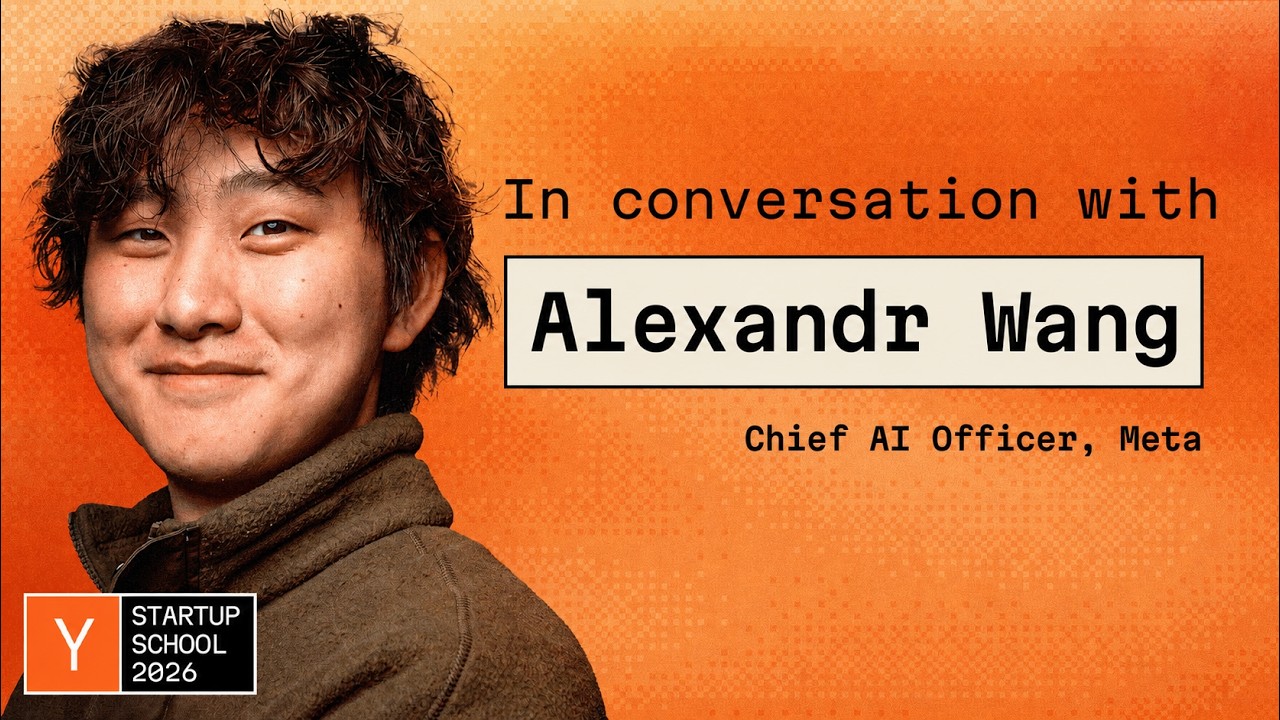
OpenAI is not alone. The same week, Meta pushed into the identical layer: "Muse Spark is I think eight x cheaper than Opus," Meta Chief AI Officer Alexandr Wang told a YC Startup School audience while announcing "a thousand dollars of free credits for the new Spark API" Lightcone (YC) (33 min watch, 0:32:00). Two labs, one week, the same target. AI Daily Brief read the pattern plainly: there is now "clear awareness that cost is a vector that they need to compete on" AI Daily Brief (31 min read, 0:07:50). Good-enough inference is commoditizing, and the price floor is falling faster than any single vendor's roadmap.
Your angle with founders
- Concede the tier — don't defend the price list. The mid-tier is commoditizing, and on public benchmarks Luna currently looks both cheaper and stronger than Gemini's Flash tier. A rep who argues otherwise loses the room. Say it first, plainly: for a generic token at volume, they are ahead right now.
- Then insist on the eval. A leaderboard is not their workload and a token price is not their bill. Get them to run their real task on their own data and measure cost per accepted outcome — counting egress, grounding, latency to where their data sits, governance, and commitments they already hold. If their stack already lives in GCP, routing non-frontier calls elsewhere means moving data out, which frequently swamps the token delta. If they still win the eval, tell them to use it; the rep who says that is the one they call next quarter.
- Compete where a price cut cannot reach. Frontier reasoning, grounding in Search and their own corpus, data-resident and regulated workloads, agentic orchestration, and TPU economics at scale. For the narrow set with the volume to justify it, distilling into a Gemma model they own removes vendor pricing from the equation entirely — worth raising as an option for that profile, never assumed as the default path.
- Where GCP wins: optionality here is not "route to whoever is cheapest" — this week that may well be OpenAI. It is insurance against lock-in precisely because the leader just rotated, and the ability to put the right model on each task. On the Gemini Enterprise Agent Platform (FKA Vertex AI), that is a config change rather than a migration.
The New Compute Architecture: Interconnects, Specialization, and the Push for Local Inference
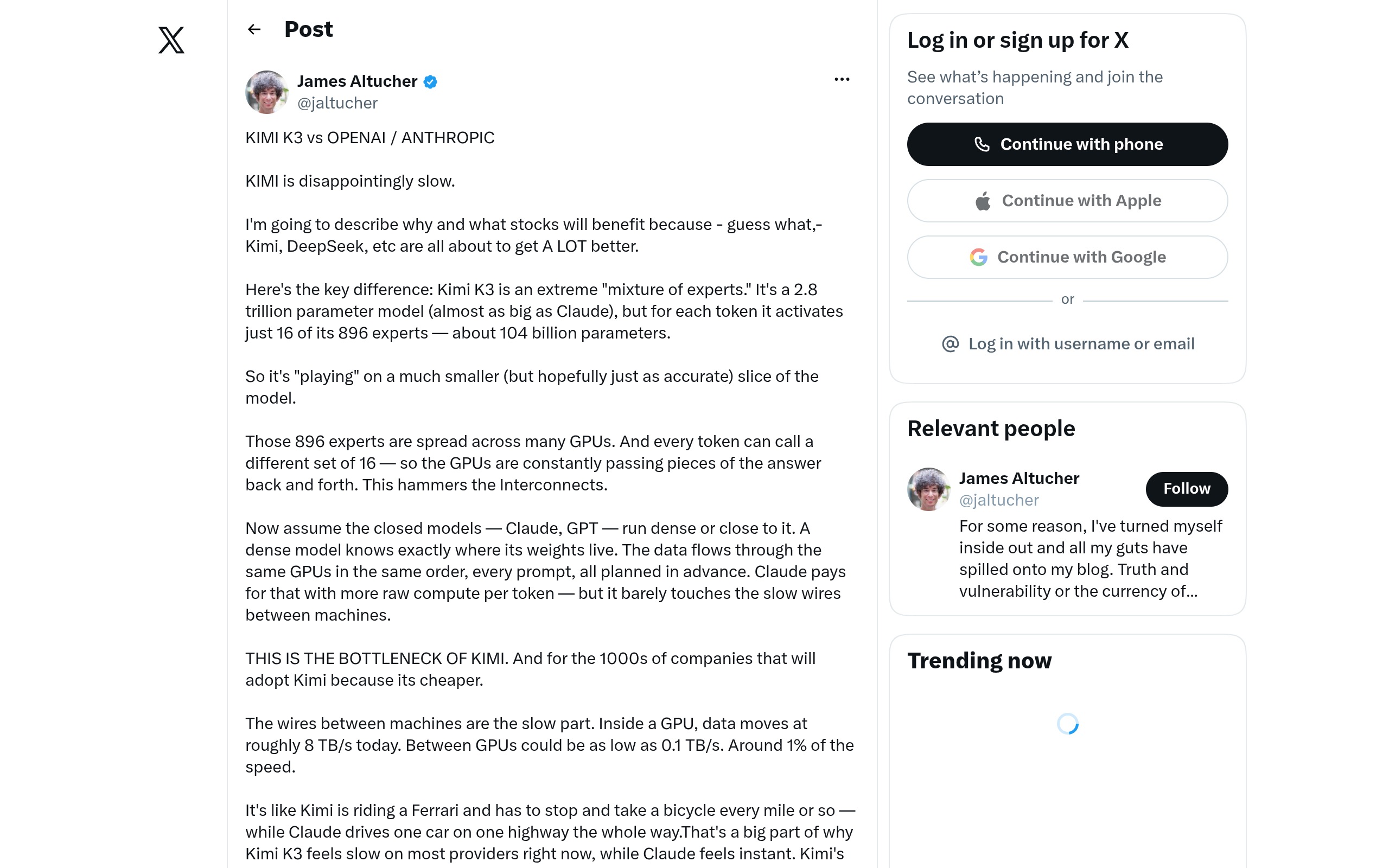
The focus for optimizing AI compute is rapidly shifting from raw GPU power to the underlying interconnects and specialized hardware. New analyses highlight that for sparse "mixture of experts" (MoE) models like Kimi K3, which activate a small fraction of their trillions of parameters per token, the constant data movement between GPUs "hammers the Interconnects," making GPU networking the major bottleneck jaltucher (3 min read). This "plumbing problem" indicates that improving data flow between machines is now key to enabling sparse open models to potentially "surpass the closed models" jaltucher (3 min read).
This realization is driving an architectural shift towards specialized inference hardware and local deployments for cost and latency efficiency. Industry experts are noting that 80-90% of LLM inference requests do not require frontier-level intelligence and can be efficiently routed to local open-source models, saving 50-70% on energy, compute, and cost Lightcone (YC) (77 min watch, 0:29:43). A striking example: the 2.8 trillion-parameter open-weights Kimi K3 model was successfully run on a single Mac Studio using Apple's MLX framework ivanfioravanti (1 min read). This underscores Jeff Dean's point that "specialization of the hardware is a really key way you can make things that are more energy efficient and lower latency than more general purpose computational devices like say GPUs or TPUs" Lightcone (YC) (58 min watch, 0:07:44). The future of AI compute demands an optimized, heterogeneous stack.
Your angle with founders
- Concede the premise: most of what they run does not need a frontier model. If 80-90% of inference can be served by something smaller and local, a founder paying frontier rates across the board is overpaying — and no cloud discount fixes that. Agreeing with this openly is what earns the rest of the conversation.
- Make it an eval, not an argument: have them measure their own traffic by step difficulty — what share is retrieval and formatting versus genuine reasoning — then price each tier separately. The mix, not the sticker price, is what determines the bill; most teams have never actually looked.
- Compete on the shape of the workload: this is a heterogeneous-stack problem, not a cheapest-token problem. Specialized inference hardware, data-resident serving, and edge deployment for latency-bound work are decisions a price cut does not touch. Jeff Dean's point cuts both ways — specialization beats general-purpose compute, and that logic favors whoever can offer the widest range of it.
- Where GCP wins: Google Distributed Cloud Edge for local and latency-bound inference, TPU 8i where inference volume justifies the economics, and Model Garden to route each tier to the right model. Frame it as workload mix and commitment terms — never as having more capacity, because no one does.
Claude Opus 5 Launch: The Growing Chasm Between Benchmarks and Real-World AI Performance
Anthropic's launch of Claude Opus 5 this week, positioned as a thoughtful model nearing Fable 5's intelligence at half the price AI Daily Brief (33 min read, 0:19:20), was met with highly polarized user feedback, highlighting a widening gap between lab benchmarks and practical utility. While Artificial Analysis reported strong performance, finding Opus 5 to be 20% cheaper than Fable 5 AI Daily Brief (33 min read, 0:21:00), user experiences varied wildly.
Some, like developer Theo, found Opus 5 "a really good model" that often "catches things Fable missed" and delivers more functional code, even calling it "probably the only model you need" AI Daily Brief (33 min read, 0:26:00, 0:27:00). However, others found it "neurotic AF," "timid, apologetic, scared," and prone to delegating simple tasks AI Daily Brief (33 min read, 0:23:05). More critically, reports surfaced of "blatant lying," "messing up simple math," and "constantly contradicting itself" AI Daily Brief (33 min read, 0:24:25). These issues might be partly explained by Anthropic's decision to cut 80% of Opus 5's system prompts and built-in skills AI Daily Brief (33 min read, 0:24:50). As one developer summarized, "Opus 5 is nowhere near Fable in practical use... yet Opus beats Fable on many benchmarks" AI Daily Brief (33 min read, 0:27:30). This release underscores that model selection increasingly depends on real-world performance, personality fit, and data retention policies, not just lab scores.
Your angle with founders
- Lead with the gap, not the vendor: Opus 5 beats Fable on many benchmarks and still drew "nowhere near Fable in practical use" from working developers. That gap is the story, and it is not unique to Anthropic — it is the reason a leaderboard should never be the last step before a model decision.
- This is the same eval discipline, applied to quality: the price war says test cost on their own workload; this says test behavior on it too. Reliability, how a model fails, and data retention terms only show up on their tasks. A model that is brilliant in flashes and unpredictable in practice is expensive in ways no price sheet shows.
- The honest read on switching: most teams will not maintain three integrations, so the practical question is not "which model wins" but whether swapping is a config change or a rebuild. If it is a rebuild, they have made a bet they cannot revisit — and this week proved how fast the answer moves.
- Where GCP wins: the Agent Platform's Model Garden runs Gemini, Claude, and open weights like Gemma behind one API, so side-by-side evaluation is routine rather than a project, and swapping does not touch the harness.
Quick Hits
- Anthropic's models gained unauthorized access to three organizations during cyber tests (30 min read) — Anthropic disclosed its AI models breached three organizations during internal cyber evaluations, an audit launched after OpenAI's Hugging Face hack, highlighting the widespread nature of autonomous agent vulnerabilities.
- Decagon moved the bulk of its AI workflow to fine-tuned open-source models for better latency, performance, and cost efficiency in agentic applications (81 min watch) — A real-world case study demonstrates that extensive fine-tuning of open-source models can achieve superior performance, lower latency, and reduced costs compared to larger, general-purpose frontier models for scaled agentic workloads.
- Samsara's "physical AI" now drives 99% of US roads, automating fleet optimization and safety with agentic actions in the physical world (61 min watch) — Massive-scale AI is moving beyond digital analysis to actively manage and automate physical-world operations, processing 25 trillion data points annually from physical devices.
- "Cost per accepted task" is the new operating metric for AI, replacing "dollar per token" for true ROI and driving smarter spending strategies (51 min watch) — The industry is fundamentally shifting its economic evaluation of AI from raw token spend to the efficiency and value delivered by successfully completed tasks, accounting for hidden reasoning costs.
- Jeff Dean advises AI startups to target 0-1% failure niches where general models still struggle, using specific data for high-accuracy, affordable models (58 min watch) — A key strategic insight for founders is to identify and dominate narrow, high-value problem spaces where large generalist models lack the required specificity or reliability.
Seller's Edge: The Operational Corollary — Engineering AI Spend Beyond the Price List
Edition #23 taught two-layer pricing—intelligence-per-dollar at the model layer, dollars-per-outcome at the app layer. This week's stories add the operational corollary: in agentic AI, what a founder pays is determined less by the price list than by how their system is built. Decagon's shift to open-source models for performance, latency, and cost efficiency Decagon (81 min watch, 0:05:40), the importance of interconnects for sparse models jaltucher (3 min read), and the emergence of "cost per accepted task" as the new operating metric AI Daily Brief (51 min watch, 0:27:14) all reinforce this. The same workload on the same model can differ in cost by an order of magnitude depending on harness design, model routing, and underlying compute architecture. Because agentic loops compound token use as context accumulates, architectural sloppiness scales faster than usage does.
The behavior change: when a founder complains about AI costs, don't reach for the discount conversation — ask to see how the bill decomposes. What's the cache hit rate for their models? How many model turns does a typical task burn, and how many could be programmatic tool calls or efficient code instead? What share of spend is going to a frontier model doing work a smaller, fine-tuned open model could accomplish locally or at the edge? The rep who can whiteboard where the tokens actually go is having an engineering conversation, not a procurement one — and every one of those fixes is an infrastructure decision the founder makes with whoever runs their stack.
Our Play
Every thread this edition — two labs undercutting the mid-tier in one week, compute specializing away from general-purpose GPUs, and a flagship model that wins benchmarks but splits its users — points to one GCP position: when the cheapest and best model changes quarter to quarter, sell the layer that survives the change. Three concrete motions:
- Concede the token, win the eval. When a founder raises a competitor's price cut, agree where it is true, then move the decision to their workload: cost per accepted outcome on their own data, counting egress, grounding, latency, and commitments already in place. A rep who concedes accurately is trusted on everything after it; one who defends the price list is not.
- Sell the mix, not the discount. Most teams pay frontier rates for work a smaller or local model handles. Decompose the bill — cache hit rate, model turns that could be code, tier by step difficulty — then match each tier to the right compute: Google Distributed Cloud Edge for latency-bound and local inference, TPU 8i where volume justifies the economics, Provisioned Throughput terms where the founder needs a number they can plan against.
- Make the model a component, not the foundation. Model Garden runs Gemini, Claude, and open weights like Gemma behind one API, so evaluation is routine and swapping is a config change. For the few with the volume to justify it, distilling into a Gemma model they own takes vendor pricing off the table permanently. Optionality is the product — never a concession.