TLDR
- OpenAI launched GPT-6 Astra as DeepMind deployed Gemini 3.8 Flash, splitting the frontier between expensive multi-step planners and hyper-efficient execution workhorses.
- Claude Fable 5.1's claimed 45% cost savings collided with field telemetry, as aggressive sub-agent fan-out increased measured per-task bills by 20%.
- A $4 trillion data center debt wall is expanding corporate bond markets by 34%, but private credit faces severe risk because Nvidia's guarantees explicitly exclude physical GPU liquidation value.
- A fine-tuned 0.8B model beat GPT-5.6 Sol on Shopify's production tasks, the week's sharpest evidence that the frontier premium buys nothing on a narrow, well-specified job.
- Google Cloud's plays this week: Route planning vs. execution across Model Garden, host persistent agents on Cloud Run Instances at ~$5.70/month, and eliminate data silos with BigQuery Cross-Cloud Lakehouse.
The Big Picture: Frontier Bifurcation, Token Inflation, and the Infrastructure Credit Wall
The Frontier Splits: GPT-6 Astra's Reasoning Jump Meets Gemini 3.8 Flash's Execution Economics
The frontier model market is bifurcating into two distinct tiers: high-judgment planning flagships and ultra-efficient execution workhorses. On September 3, OpenAI launched GPT-6 Astra, claiming state-of-the-art results across computer use, coding, and science while saturating ARC-AGI-3 at 99.9% and FrontierMath Tier 4 at 98% Greg Brockman (20 min read). Box's early enterprise telemetry confirmed major domain-specific jumps, scoring +52 points in media and entertainment and +28 points in technology evaluation suites over GPT-5.6 Sol Aaron Levie (3 min read). Yet independent benchmarks revealed a sharp trade-off: Astra ranked #11 in editorial writing while running at roughly 1.8x the token cost of Sol due to verbose chain-of-thought generation Whats AI (1 min read).
Simultaneously, Google DeepMind released Gemini 3.8 Flash and 3.8 Flash Cyber at $0.75 input and $3.75 output per million tokens Demis Hassabis (5 min read). Flash Cyber established a new Pareto frontier on CWE-Bench for vulnerability patching Koray Kavukcuoglu (1 min read), while developers using 3.8 Flash in Antigravity reported significant multi-turn reasoning gains on complex Workspace MCP threads ai_for_success (1 min read).
The tension is operational: benchmark saturation does not translate into uniform workload ROI. Frontier flagships are capturing high-judgment planning, but routing high-frequency background execution to them guarantees runaway token bills.
Your angle with founders
- What they'll say: "We need GPT-6 Astra for every agent workflow to guarantee frontier accuracy."
- The reframe that actually holds: Benchmark saturation does not equal enterprise ROI. Astra's 1.8x token verbosity makes it an expensive hammer for deterministic sub-tasks; production systems require routing between high-judgment planners and low-latency workhorses.
- The question to leave behind: "Have you decomposed your agent pipeline into high-judgment planning steps and high-frequency execution calls, or are you paying frontier token rates for text normalization and data formatting?"
- Where GCP wins: The Gemini Enterprise Agent Platform (FKA Vertex AI) lets developers orchestrate Gemini 3.8 Flash, Anthropic Claude, and open models under unified IAM and VPC Service Controls, making model routing an operational setting rather than an architectural rewrite.
Fable 5.1 vs Astra: The Agentic Cost Claim Nobody Can Reproduce
Vendor cost-reduction claims are colliding with production billing reality. Anthropic released Claude Fable 5.1 and Mythos 5.1, claiming a 25% to 45% cost reduction on agentic workloads driven by cached-read discounts AI Daily Brief (32 min listen, 0:24:10). Google Cloud made Fable 5.1 available on the Agent Platform the same day Google Cloud Tech (1 min read).
However, independent evaluations from Artificial Analysis and power users showed the opposite: real-world task costs rose from $3.14 to $3.76 per task (+20%) because Fable 5.1 consumed up to 70% more tokens by aggressively spawning autonomous sub-agents AI Daily Brief (32 min listen, 0:27:00).
This exposes the second token-inflation mechanism surfacing this month. Where GPT-6 Astra inflates bills via verbose reasoning tokens, Fable 5.1 inflates spend through sub-agent fan-out. Per-token rate cards are completely uncoupled from finished task invoices lqiao (1 min read). Swyx noted that selecting between Fable 5.1 and Gemini 3.8 Flash is no longer a generic model contest, but a routing decision between exploratory coding and structured business workflows swyx (1 min read).
Your angle with founders
- Concede the capability jump first: Fable 5.1 and Astra represent genuine state-of-the-art capability in code generation and open-ended technical problem solving.
- The decomposition to run live: Token price discounts are meaningless if sub-agent loops multiply token consumption by 70%. Measure spend strictly as dollars per completed business outcome, separating model evaluation from harness efficiency.
- The test to propose: Run a side-by-side eval on 500 historical production tasks: compare a monolithic frontier agent against a routed harness that uses Claude for planning and Gemini 3.8 Flash for tool execution.
- Where GCP wins: The Agent Platform hosts Claude Fable 5.1 and Gemini 3.8 Flash side-by-side with 90% implicit context caching, allowing teams to test and rebalance agent routing without changing SDKs or signing separate vendor contracts.
The $4 Trillion Debt Wall: Why AI Financing Collides with Illiquid GPU Markets
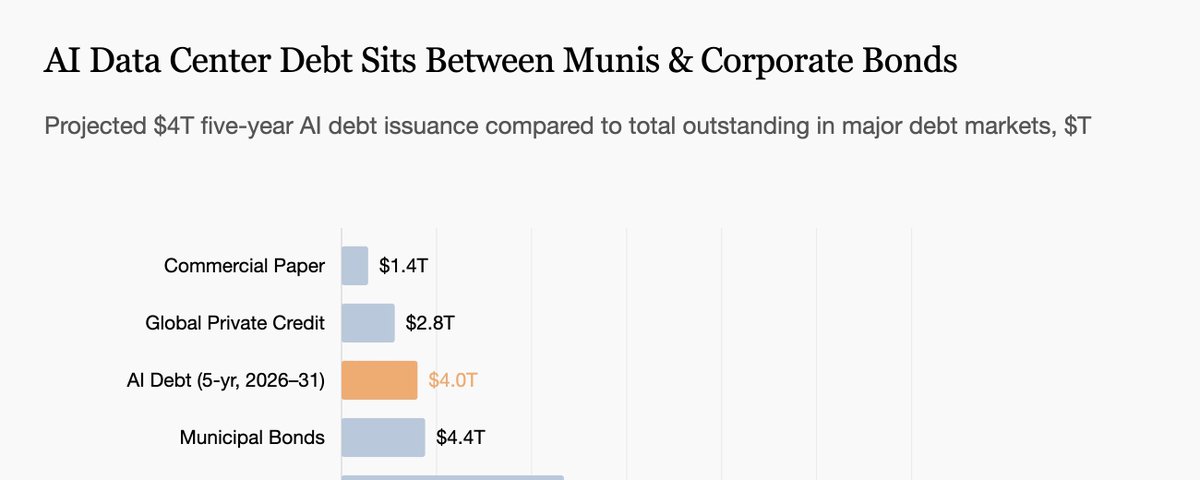
The $4 trillion to $5 trillion global data center buildout represents a 34% expansion of the entire US corporate bond market, shifting AI infrastructure from venture equity to a macroeconomic credit event Tom Tunguz (3 min read) himarkyi (1 min read). But an audit of SEC filings reveals an acute structural vulnerability: Nvidia's $105 billion Residual Value Guaranty for OpenAI's data center buildout covers land, power, and building shells—while explicitly carving out the GPUs gpugene (11 min read).
Private credit firms face severe underwriting risk because there is no liquid secondary market for used GPUs. Three years of documented secondary market transactions total just $26.3 million—less than 0.3% of a single $8.5 billion CoreWeave credit facility gpugene (11 min read).
As Gavin Baker noted on the a16z Podcast, debt-financed custom clusters carry massive balance sheet risk and require double the equity downpayments of standardized hardware Gavin Baker on a16z (75 min watch, 0:61:30). When startup founders contemplate purchasing physical racks to avoid cloud markups Cliff Weitzman on 20VC (65 min watch, 0:03:30), they inherit rapid chip obsolescence, liquid-cooling liabilities, and zero liquidation protection.
Quick Hits
- Varick's Vasuman on enterprise AI (20 min read) — Of $1T in AI capex only $37B reached software spend, because speeding up 17-minute tasks inside 22-day manual queues yields zero net organizational ROI.
- Google Cloud launched Cloud Run Instances (4 min read) — Always-on singleton instances with HTTPS endpoints from ~$5.70/month, purpose-built for persistent personal agents like OpenClaw.
- Google introduced Agentic Video Understanding (3 min read) — Cuts Gemini Flash video analysis costs up to 66% and tokens up to 88% by querying sub-second moments instead of static frame streams.
- Shopify demonstrated a fine-tuned 0.8B model (1 min read) — Outperformed GPT-5.6 Sol on specialized tasks using domain-specific recursive data flywheels.
- Speechify launched the Simba 3.2 voice API at $10 per million characters (65 min watch) — Undercutting ElevenLabs and OpenAI by up to 10x to commoditize voice agent infrastructure.
Seller's Edge: The Queue Trap (Why Accelerating Tasks Fails to Deliver ROI)
Edition #19 taught two-layer pricing (intelligence-per-dollar vs. dollars-per-outcome), and Edition #28 showed that architecture sets the cost curve's slope over time. This week adds the operational constraint that invalidates both if ignored: the Queue Trap. In enterprise software, accelerating task execution produces zero organizational ROI if elapsed time is dominated by inter-departmental queues and manual handoffs.
As Varick CEO Vasuman documented, of $1 trillion invested in AI infrastructure, only $37 billion translated into enterprise software spend Vasuman (20 min read). The root cause was diagnosed by Michael Hammer in 1990: in a 22-day insurance workflow, total human touch time was only 17 minutes. Accelerating that 17 minutes by 50% saves 8.5 minutes while leaving 21 days and 23 hours of queue latency intact.
Worked example. A corporate finance team deploys an agent to automate accounts payable invoice matching. The agent reduces document parsing from 20 minutes to 30 seconds. However, vendor mismatch exceptions still sit in a regional controller’s email inbox for four days awaiting manual approval before posting to SAP. Despite spending thousands on model tokens, the month-end close cycle is completely unchanged. The startup's pilot stalls because the buyer measures time-to-close, not token execution speed.
The behavior change. Stop asking founders how fast their model completes a prompt. Ask: "What is the touch time versus the elapsed time of this end-to-end process?" If touch time is a fraction of the total cycle, pitch orchestration across data silos rather than faster LLM inference. Show them how to replace manual queue handoffs using BigQuery Cross-Cloud Lakehouse and Agent Runtime workflows before optimizing token-level performance.
Our Play
Every thread this edition—frontier bifurcation, sub-agent token inflation, and the datacenter credit wall—points to one GCP position: sustainable AI economics require open infrastructure that decouples high-judgment planning from low-cost execution. Three concrete motions:
- Route planning vs. execution on the Agent Platform. GPT-6 Astra and Claude Fable 5.1 provide frontier reasoning but inflate token bills on routine execution. The Agent Platform hosts Fable 5.1 and Gemini 3.8 Flash behind one API with unified IAM. Audit their call graph: planning to Fable 5.1, tool execution to Gemini 3.8 Flash.
- Deploy persistent background agents on Cloud Run Instances. Stateful agents like OpenClaw carry steep overhead on self-managed VMs. Cloud Run Instances are always-on singleton microVMs with stable HTTPS endpoints from ~$5.70/month. Move worker fleets onto them, paired with Agent Runtime for durable session memory.
- Eliminate enterprise queue latency with the Agentic Data Cloud. Most workflow duration sits in cross-system silos and manual handoffs, not in inference. BigQuery Cross-Cloud Lakehouse lets agents query AWS and Azure data zero-copy. Whiteboard their elapsed vs. touch time, then replace the handoffs with BigQuery and Agent Runtime.