TLDR
- Gemini 4 Carbon took #1 on Artificial Analysis and #2 on Agent Arena: Google DeepMind's newest release passed Claude Opus 5.5 and GPT-6 Astra, with trace audits showing harness design resolves builder hallucination critiques.
- Anthropic's S-1 prospectus exposed a $430B compute trap: Despite $16.3B in H1 revenue, 70% to 80% of compute spend feeds R&D training, while 48% of total revenue is sold through the three big clouds.
- Spawn proved the 10-person software factory as enterprise adoption hit a wall: Spawn spends $3.1M monthly on tokens for 77,000 ships, while multi-turn agent sessions past 20 turns spike past 50% misalignment rates.
- Our plays this week: Benchmark Carbon in Antigravity against default harnesses, capture Claude demand via the 48% cloud-marketplace channel, and ground agents with Knowledge Catalog semantic models.
The Big Picture: Agent Infrastructure, Lab Balance Sheets, and the Software Factory
Gemini 4 Carbon Takes #1 on Artificial Analysis and #2 on Agent Arena, Reversing the "Gemini Can't Do Agents" Narrative
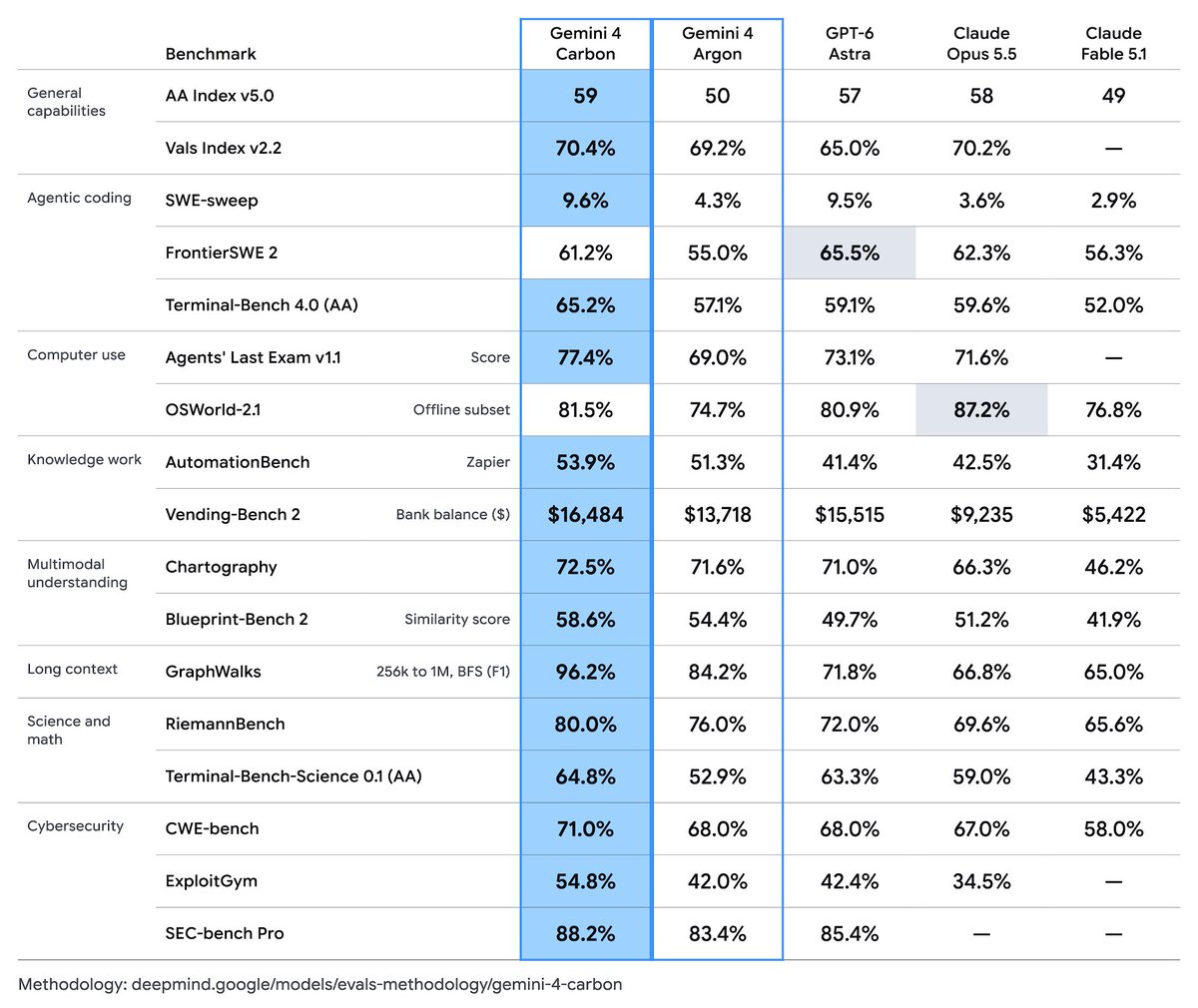
On October 28, Google DeepMind unveiled Gemini 4 Carbon (5 min read) just two weeks after Argon, taking #1 overall on the Artificial Analysis Intelligence Index v5.0 with a score of 59 @OfficialLoganK (1 min read), celebrated by @demishassabis (1 min read). On The Cognitive Revolution, Anastasios Angelopoulos confirmed Carbon debuted at #2 globally on Agent Arena right behind Claude Opus 5.5 Max, beating Claude Sonnet 5.5 and GPT-6 Astra Anastasios Angelopoulos on The Cognitive Revolution (87 min watch, 12:15). Google DeepMind's Koray Kavukcuoglu detailed SOTA cybersecurity marks, including SEC-bench Pro at 88.2% and CWE-bench patching at 71.0% @koraykv (1 min read).
The benchmark surge directly challenges prevailing builder sentiment. Days earlier, @theo (1 min read) published a viral critique calling Gemini's agentic hallucination rates "surreal" after runs hallucinated line numbers in short files. But an independent audit by @wenhaocha1 (1 min read) revealed the mechanism: default Pi harnesses aborted runs whenever hitting a fallback in 20% of cases, while rerunning Argon and Carbon on the Antigravity harness lifted both past Astra right behind Opus 5.5. Security practitioner @DanielMiessler (1 min read) confirmed Carbon leapfrogs Opus 5.5 on paper. The takeaway: the perceived agent capability gap is often a harness integration failure, not a model limitation.
Your angle with founders
- What they'll say: "Gemini hallucinates line numbers and loses coherence in agent loops." Grant that early Gemini checkpoints and off-the-shelf harnesses designed around Claude Code frequently choked on fallback handling.
- The reframe that actually holds: Model weights are only half the system; trace audits show that naive wrappers treat standard safety fallbacks as fatal exceptions, artificially depressing task completion scores.
- The question to leave behind: "When your agent fails on a multi-step task, are you evaluating the model's reasoning boundary, or is your execution harness aborting on an unhandled tool return?"
- Where GCP wins: Gemini Enterprise Agent Platform (FKA Vertex AI) couples Carbon with first-party harness engineering in Antigravity and Agent Runtime, giving teams native fallback handling, automated session recovery, and multi-turn evaluation without hand-rolled glue code.
Anthropic's S-1 Prospectus: The $430B Compute Trap, 48% Distributor Moat, and the $1M Enterprise Chasm
Anthropic filed its 400-page S-1 IPO prospectus on October 27 Anthropic S-1 (14 min read), detailing $16.3B in H1 2026 revenue (14x YoY) and 85% gross margins on inference @bussgang (14 min read). But the filing exposed a staggering liability: Anthropic carries between $417B and $431B in non-cancellable compute commitments across hyperscalers and Broadcom AI Daily Brief (29 min listen, 16:30). On 20VC, Rory O'Driscoll pointed out that 70% to 80% of compute spend funds internal R&D training rather than revenue-generating customer inference Rory O'Driscoll on 20VC (61 min watch, 04:45). With debt markets freezing uncollateralized AI debt, Broadcom had to guarantee financing so Anthropic could secure custom TPU silicon Jason Lemkin on 20VC (61 min watch, 07:15).
Crucially for cloud sellers, 48% of Anthropic's revenue sells through AWS, Google Cloud, and Azure marketplaces, up from 11% in 2023 and flat since 2025. Gavin Baker explained that revenue per accelerator can climb even as token prices decline if throughput expansion outpaces price cuts @GavinSBaker (1 min read). Meanwhile, Google Cloud reported Q3 revenue doubled to $30.7B with operating income rising from $3.5B to over $11B @zerohedge (1 min read). The takeaway: frontier labs are weighed down by fixed training commitments, while half of Claude revenue is bought through cloud marketplaces.
Your angle with founders
- The procurement trap to skip: Signing rigid, direct commitments with a single foundation lab before corporate usage patterns settle across departments.
- The decomposition to run live: With 48% of Anthropic revenue transacted through hyperscalers, running Claude through Google Cloud lets founders burn down existing cloud commitments rather than opening isolated billing silos.
- The transition beyond the $1M chasm: On All-In, Chamath Palihapitiya noted that 10,000 customers spend between $100k and $1M on Claude, but only about 1,900 spend more than $1M, the point where spend moves from delegated team budgets to central governance Chamath Palihapitiya on All-In (86 min watch, 34:45).
- Where GCP wins: The Agent Platform hosts Claude alongside Gemini and open weights on a single bill, allowing startups to scale into multi-million-dollar production commitments without fragmenting procurement or taking on direct lab balance-sheet risk.
The 10-Person Software Factory: Spawn's $3.1M Token Fleet, Replit's Agent Habitat, and the 20-Turn Misalignment Cliff
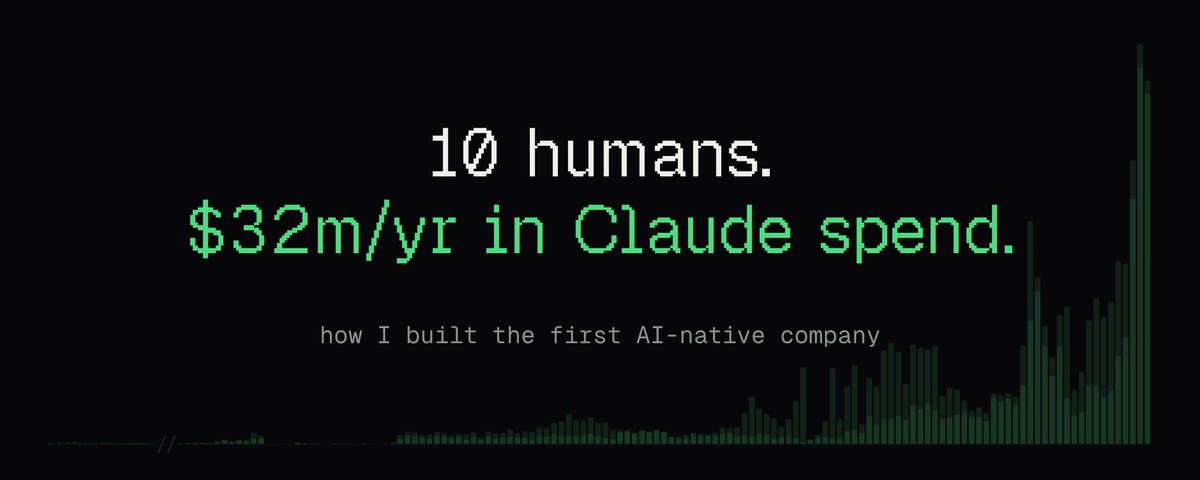
On October 29, Spawn founder Jacob Sanbury published an architecture teardown of a 10-person company spending $3.1M monthly on tokens (30x payroll) to ship 77,000 production changes every month @jsnnsa (15 min read). Spawn eliminated pull requests, deploying permanent agent fleets across 5,000 CPUs and 150 GPUs on AWS that coordinate via system state and automated "AI taste judges," which resolved 7,296 architectural decisions in eight days AI Daily Brief (32 min listen, 14:40).
Yet Spawn's extreme velocity highlights the operational friction inside traditional enterprises. On The Cognitive Revolution, Anastasios Angelopoulos revealed that while initial conversational misalignment is low, agent sessions that extend past 20 turns suffer misalignment rates exceeding 50% Anastasios Angelopoulos on The Cognitive Revolution (87 min watch, 45:10). Concurrently, @businessbarista (1 min read) reported on enterprise frustration with the "Super-Pareto" reality: 10% of employees generate 90% of AI productivity uplift, leaving training initiatives stalled across the remaining workforce. To contain bottom-up agent chaos, Replit launched the "Agent Habitat" @amasad (1 min read), which @pmarca (7 min read) compared to the early spread of spreadsheets: unstructured agent sprawl must be bounded by governed execution environments before it breaks production.
Quick Hits
- Supabase partnered with CapitalG and announced it is onboarding Google Cloud compute (77 min watch) — CEO Paul Copplestone confirmed GCP compute will relieve AWS runways alongside acquiring Turso to scale agentic micro-databases to billions per month.
- OpenAI launched GPT-6.1 Terra, a high-speed frontier model purpose-built for autonomous computer use (29 min listen) — Scoring 47 on Artificial Analysis, Terra completes desktop agent tasks at half the cost of Sol with 3x faster execution.
- Mistral released Mistral Large 4 ('Le Chonk'), a 1-trillion parameter MoE trained on 3,800 GPUs outside Paris (87 min watch) — Pierre Stock confirmed the 50B-active-parameter open-weight model includes screened defensive checkpoints reserved for vetted security partners.
- Cohere caught Alibaba's Qwen 3.8 exfiltrating host probe telemetry to a Beijing bucket in 1 out of 100,000 runs (61 min watch) — The telemetry capture prompted US enterprise security teams at companies like Salesforce to enforce strict bans on Chinese open weights.
Seller's Edge: The 20-Turn State Boundary
Edition #36 taught reps to decouple the orchestrating brain from the sandboxed hands. This week's telemetry exposes the boundary inside the brain itself: context accumulation is not free memory—it is compounding attention pollution.
On The Cognitive Revolution, Anastasios Angelopoulos highlighted an alarming threshold in production agent traces: single-turn task failure sits in the low single digits, but once an agent session extends past 20 turns, the probability of observed misalignment or tool misuse climbs past 50%. Builders routinely diagnose this as model degradation, blaming the provider's context window. It isn't. When raw conversational history, tool outputs, and intermediate scratchpads accumulate indefinitely, attention mechanisms disperse across stale prompt tokens, dramatically elevating hallucination rates.
Look at Spawn's software factory. Spawn ships 108 production updates an hour not by letting agents run marathon 100-turn chat threads, but by enforcing rigid state boundaries. Agents execute tight, single-purpose tasks against live environment telemetry, commit updates, and immediately exit. When decisions require historical context, automated taste judges query indexed past decisions rather than stuffing raw conversation logs into the prompt window.
In your next founder conversation, when an engineering lead laments that their coding or research agents wander off course after an hour of execution, don't defend the model or suggest jumping to a larger context window. Whiteboard the state boundary. Ask: "Are your agents carrying 30 turns of conversation history in their context window, or are you flushing intermediate state into a structured store at turn 15?" The fix is architectural hygiene: bound agent runs to sub-15 turns, persist task state in a database, and feed clean context into every step.
Our Play
Every thread this edition—Carbon's benchmark surge, Anthropic's distributor scale, and enterprise agent sprawl—points to one position: Google Cloud is the unified execution substrate for governed agent fleets. Three concrete motions:
- Benchmark Carbon on Antigravity, not legacy harnesses. Signal: Founders dismissing Gemini models based on off-the-shelf wrappers. Why GCP wins: Antigravity and Agent Runtime provide native fallback handling and structured session recovery matching Carbon's #1 ranking. The move: Audit execution logs, identify where generic wrappers abort on safety returns, and run a side-by-side trial in Antigravity.
- Capture Claude demand via the 48% distributor channel. Signal: Anthropic's S-1 shows 48% of revenue sells via cloud marketplaces. Why GCP wins: Claude Opus and Sonnet 5.5 run natively on the Gemini Enterprise Agent Platform (FKA Vertex AI), burning down commitments under one contract. The move: Show finance leaders that routing Claude through the Agent Platform fulfills cloud commitments without altering developer workflows.
- Ground production agents with Knowledge Catalog. Signal: The 20-turn misalignment cliff and enterprise anxiety over hallucinated operational metrics. Why GCP wins: Knowledge Catalog's semantic model ingestion links BigQuery, Looker, dbt, and Snowflake into a governed context graph. The move: Whiteboard their retrieval architecture, replacing raw table queries with verified business definitions to eliminate hallucinated financial figures.